
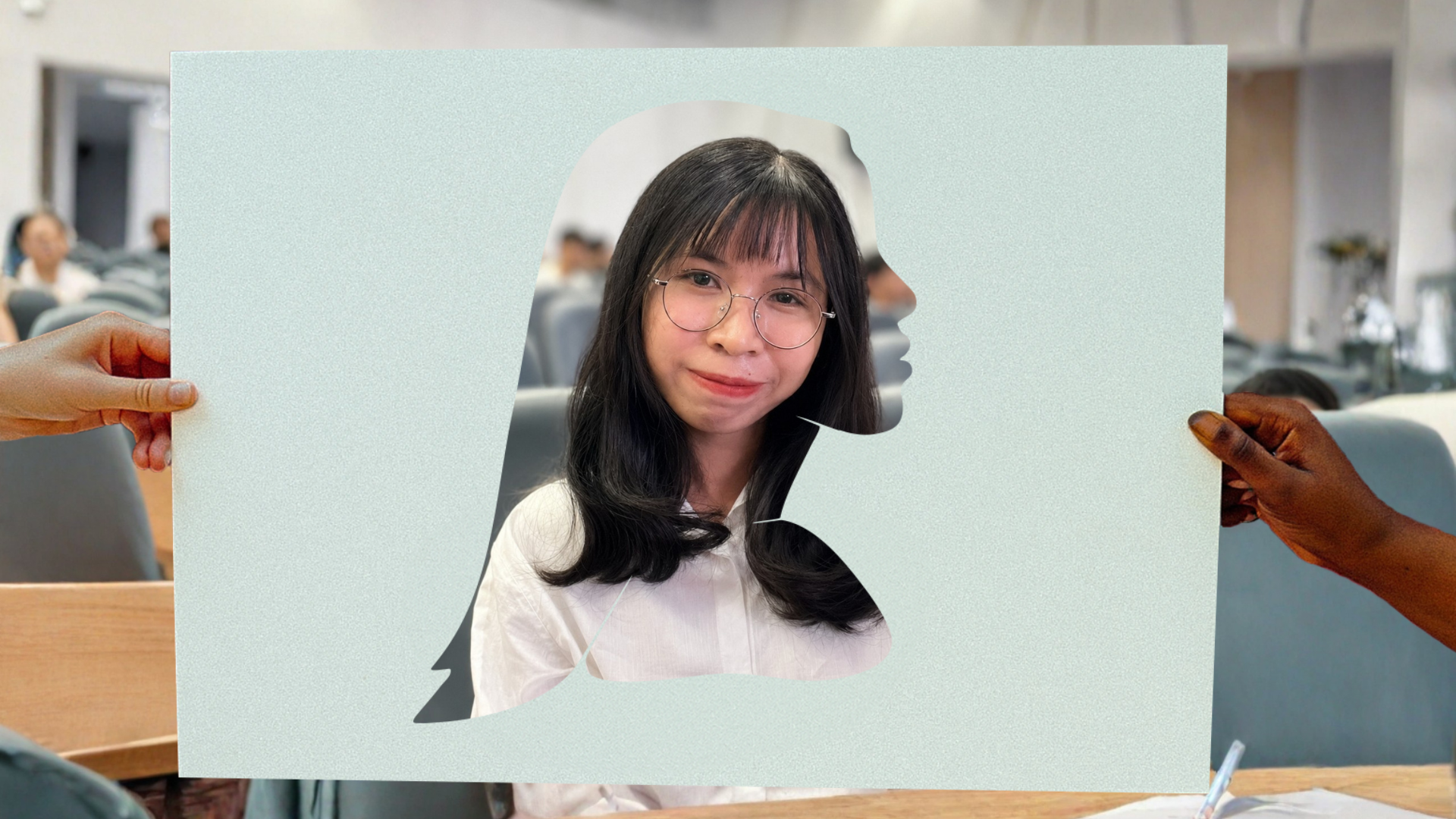
Never stop learning. If you learn more and more, opportunities will come.
Career: Chemical Engineering
Meet Hân Nguyễn Thị Ngọc. The floors were clean, not because the house ran smoothly on its own, but because Hân had scrubbed them after school, the way she did each day. The front doorway was neatly swept. A stack of homework waited on the counter, finished between chores. The sound of rice bubbling drifted through the air, rice she had measured and washed herself so her mother would have one less thing to do after returning home from the fields.
To anyone else, these might have been ordinary details, but to 10-year-old Hân growing up in a small farming village, six hours outside Ho Chi Minh City, they were the quiet signs that the day’s work was done. Each chore finished meant a few more precious minutes she could claim as her own. Only when everything was in order, when the house was quiet, when no one needed anything from her, could she pull out her brother’s old textbooks. Between the battered covers it wasn’t comfort that waited for her then, but possibility.
From a young age, Hân Nguyễn Thị Ngọc pushed herself to gain the knowledge and insight she had long dreamed of. It all began with teaching herself to read.
The youngest in her family, Hân was raised by parents who understood the hardships of agricultural life, work resulting in chronic illness but also the opportunity that came with continued education. Though money was scarce, her parents worked tirelessly, well beyond the age when others might retire, to ensure that both she and her older brother could pursue their dreams beyond the rice fields.
Hân’s educational journey began early with Room to Read, whose Girls’ Education Program gave her the structure, encouragement, and the academic foundation she needed in the most formative years of her life. That program, she said, opened a new world. “Room to Read taught me so many skills, how to take care of myself, how to stay safe, how to think about my future. It also helped my parents understand the importance of education.” For the first time, Hân felt that school wasn’t just something she attended, it was something she could build her life around. Those early years of support strengthened her confidence and laid the groundwork for everything that came next.
When Hân looks back on these early years, she often thinks of her brother, her first teacher, the role model, who taught her to never stop learning. “My brother is eleven years older than me,” she explained. “He was always my idol. He studied hard, he learned new things, and I wanted to become a person like him.” She went on to explain how he was the one who pushed her to keep learning new languages, especially Japanese and English; essential tools she has carried into her life and career today.
Books became her escape and her fuel. She taught herself to read from the books her brother left behind and from those she borrowed from the school library. “When I was seven, I tried to read Harry Potter,” she said with a shy laugh. “It was really a huge book for me. But I thought it was interesting, so I tried to understand it.” She remembers flipping through her brother’s high school textbooks, long before she could understand the equations. “I didn’t understand the words,” she said, “but I wanted to. I thought science was interesting, so I wanted to learn more.”
That same curiosity eventually extended beyond books to cultures beyond her village. From a young age, Hân found herself drawn to Japanese culture and deeply inspired by the Japanese work ethic; the discipline, precision, and dedication to continuous improvement. She began studying Japanese because she believed it would be beneficial for her future career. “At that time,” she said, “I never imagined I would actually have the opportunity to work in another country.”
This quiet determination eventually carried her all the way to Ho Chi Minh City University of Technology, where she studied Chemical Engineering. But the journey wasn’t easy. Leaving home for the city, six hours away from her family, was a shock. “At first, it was really hard,” she said softly. “I cried. I missed my parents. But I joined a volunteer club, I made friends, and I learned to explore the city.”
When Hân began university, her family’s financial situation weighed heavily on her. Her father suffered from chronic Hepatitis B, and her parents continued farming every day to support their children’s education. Without assistance, Hân knew she would have had to work as a tutor or take on multiple jobs to cover tuition, making it difficult to study.
Then came the turning point: the U-GO scholarship. “If I didn’t receive the scholarship,” Hân said, “I think I would have struggled a lot. I would have had to work part-time, and it would have been very hard to balance everything.” The scholarship primarily covered her tuition fees, easing a significant burden on her family, who then only had to manage living expenses and other academic costs. More than financial support, the scholarship provided stability. “It gave me freedom, the freedom to focus on my studies, to improve my Japanese, to join social and volunteer activities, and to develop soft skills.”
That freedom allowed Hân not just to succeed academically, but to grow as a person. She dedicated herself to learning, expanding her worldview, and preparing for opportunities beyond graduation.
Those opportunities came sooner than expected. After graduating from university and earning a Japanese language certification, Hân met the basic qualifications to pursue work in Japan. Through a Facebook group for job postings, she reached out to a recruiter, who then connected her with a Japanese company. After completing the interview process, she was hired.
Her company sponsored her visa application and provided the necessary guarantees, allowing her to obtain a work permit and officially begin her career abroad. Today, Han works in product development at a cosmetics company in Japan—a role that reflects both her technical background and her long-standing admiration for Japanese professionalism.
Moving abroad was both exciting and terrifying. “My mother was very worried,” she admitted. “My Japanese was not great, and I was alone in a new country. But I believed it was a good opportunity. I wanted to see more, learn more.”
Despite everything she’s achieved, Hân remains anchored by gratitude, to her brother, to her parents, and to the programs that helped her shape a future she once only read about in borrowed books. “I love learning,” she said. “Each opportunity to learn brings me closer to my dream.”
When she was asked what she would tell her younger self, the girl who studied by lamplight after finishing chores at home. Hân thought for a moment, then smiled: “Never stop learning. If you learn more and more, opportunities will come.”